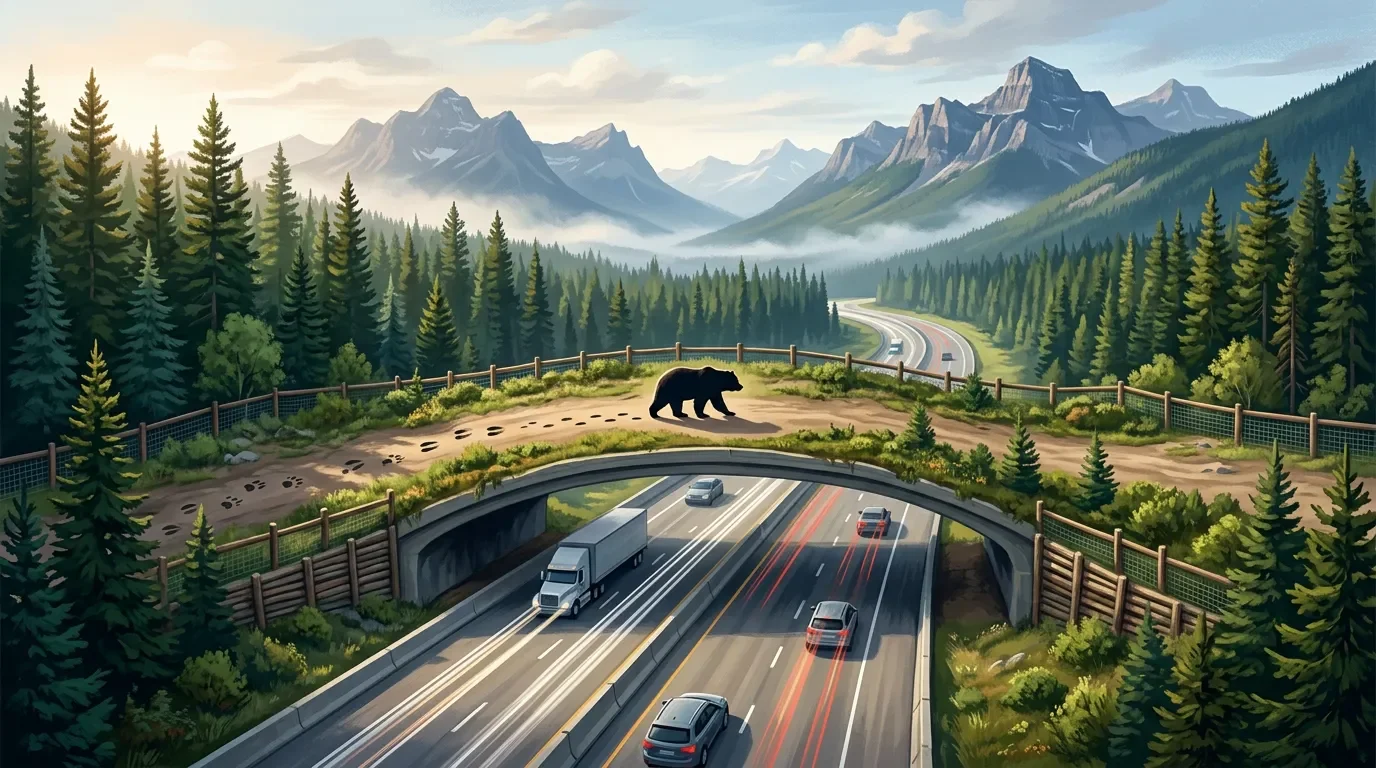
Listening practice: The bridge built for animals1×0:008:200:00Part one: first English listening2:51Part two: Chinese explanation and vocabulary5:30Part three: English replay0:00English NarratorImagine a bridge over a busy highway, but no cars are allowed to use it. The bridge is covered with soil, grass, shrubs, and young trees. At night, a grizzly bear steps onto it. Later, deer follow the same quiet path. Below them, headlights move along the road, but the animals never have to touch the traffic lane. According to Parks Canada, this is not a scene from a children’s story. It is part of a real system of wildlife crossings in Banff National Park, where roads run through mountain habitat used by bears, wolves, elk, deer, and many smaller animals.0:35English NarratorThe problem begins with a simple fact: animals move. They move to find food and water, to look for mates, to escape danger, and to reach safe places for raising young. Parks Canada explains that roads can divide the land into scattered patches of habitat. A road may look narrow on a map, but to an animal, fast traffic, noise, and open pavement can become a wall. If animals cannot move freely, groups may become separated. Over time, that can weaken gene flow, which means the exchange of genes between groups. Wildlife crossings are designed to make the road less like a barrier and more like a gap that can be crossed safely.1:13English NarratorBanff has become one of the best-known examples. According to Parks Canada, Banff National Park has forty four wildlife crossing structures: six overpasses and thirty eight underpasses, together with eighty two kilometers of highway fencing. The fencing matters because it guides animals away from the road and toward the safe crossing points. Since the first crossings were built, Parks Canada says wildlife-vehicle collisions in Banff have dropped by more than eighty percent, and by more than ninety six percent for elk and deer alone. The crossings also show that animals need time to learn. Wary species such as grizzly bears, cougars, and wolves gradually increased their use of overpasses during the first five years of monitoring.1:55English NarratorThe idea is not only about protecting famous animals in a national park. The United States Federal Highway Administration says wildlife-vehicle collisions happen more than one million times a year on U.S. roads, creating risks for people, costs for communities, and deaths for animals. In an earlier report to Congress, the agency estimated that there may be between one and two million collisions between vehicles and large animals each year in the United States. The same report says wildlife fencing, with or without crossing structures, can reduce collisions with deer and other large animals by an average of eighty seven percent. So the real lesson is this: a green bridge is not just a pretty symbol. It is a piece of science-based design. When engineers, ecologists, and local communities study where animals actually move, a road can become safer for drivers and less dangerous for the wild lives around it.2:51中文提示这一遍先抓主线。本期英文不是在讲一座普通的桥,而是在讲一种道路生态设计:wildlife crossings,野生动物通道。第一层讲画面:长满草和树的桥,让熊和鹿从车流上方过去。第二层讲原因:动物为了食物、配偶和安全地点必须移动,道路会造成 habitat fragmentation,也就是栖息地破碎化。第三层讲证据:加拿大班夫国家公园和美国联邦公路管理局的资料都说明,围栏加通道可以显著减少动物和车辆相撞。3:35中文提示重点词先听这几个。wildlife crossing,野生动物通道;overpass,是从路上方跨过去的桥;underpass,是从路下方穿过去的通道;exclusion fencing,排除围栏,把动物引向安全通道;habitat fragmentation,栖息地破碎化;ecological connectivity,生态连通性;gene flow,基因交流;mitigation,缓解措施。注意 crossing 在这里不是十字路口,而是「让动物安全通过道路的结构」。4:14中文提示再看一个长句。Wildlife crossings are designed to make the road less like a barrier and more like a gap that can be crossed safely. 主干是 Wildlife crossings are designed,也就是「野生动物通道被设计出来」。后面 to make the road... 说明目的:让道路不那么像 barrier,障碍物,而更像一个可以安全通过的 gap,缺口。听长句时先抓 designed to make,再补 less like 和 more like 的对比。4:49中文提示最后提醒两个数字。Banff 的资料里有 forty four crossing structures,四十四个通道结构,包括 six overpasses 和 thirty eight underpasses,并配有 eighty two kilometers of fencing,八十二公里围栏。美国联邦公路管理局的资料里有 more than one million wildlife-vehicle collisions a year,每年超过一百万起野生动物与车辆碰撞。复听时不要急着翻译每个词,先听出「道路切开栖息地,通道和围栏把移动路线重新接上」这条逻辑线。5:30English NarratorImagine a bridge over a busy highway, but no cars are allowed to use it. The bridge is covered with soil, grass, shrubs, and young trees. At night, a grizzly bear steps onto it. Later, deer follow the same quiet path. Below them, headlights move along the road, but the animals never have to touch the traffic lane. According to Parks Canada, this is not a scene from a children’s story. It is part of a real system of wildlife crossings in Banff National Park, where roads run through mountain habitat used by bears, wolves, elk, deer, and many smaller animals.6:04English NarratorThe problem begins with a simple fact: animals move. They move to find food and water, to look for mates, to escape danger, and to reach safe places for raising young. Parks Canada explains that roads can divide the land into scattered patches of habitat. A road may look narrow on a map, but to an animal, fast traffic, noise, and open pavement can become a wall. If animals cannot move freely, groups may become separated. Over time, that can weaken gene flow, which means the exchange of genes between groups. Wildlife crossings are designed to make the road less like a barrier and more like a gap that can be crossed safely.6:43English NarratorBanff has become one of the best-known examples. According to Parks Canada, Banff National Park has forty four wildlife crossing structures: six overpasses and thirty eight underpasses, together with eighty two kilometers of highway fencing. The fencing matters because it guides animals away from the road and toward the safe crossing points. Since the first crossings were built, Parks Canada says wildlife-vehicle collisions in Banff have dropped by more than eighty percent, and by more than ninety six percent for elk and deer alone. The crossings also show that animals need time to learn. Wary species such as grizzly bears, cougars, and wolves gradually increased their use of overpasses during the first five years of monitoring.7:25English NarratorThe idea is not only about protecting famous animals in a national park. The United States Federal Highway Administration says wildlife-vehicle collisions happen more than one million times a year on U.S. roads, creating risks for people, costs for communities, and deaths for animals. In an earlier report to Congress, the agency estimated that there may be between one and two million collisions between vehicles and large animals each year in the United States. The same report says wildlife fencing, with or without crossing structures, can reduce collisions with deer and other large animals by an average of eighty seven percent. So the real lesson is this: a green bridge is not just a pretty symbol. It is a piece of science-based design. When engineers, ecologists, and local communities study where animals actually move, a road can become safer for drivers and less dangerous for the wild lives around it.

Add more perspectives or context around this Post.